αℓιѕση уαηg
  • Home
  • About
    • Contact
  • Blog
  • Approaches to Learning Skills
    • ATL Skills Posters
  • MYP Interdisciplinary Unit
    • IDU Introduction
    • IDU Planning Process
    • IDU Assessment
    • KIS 19-20 IDU Topics
  • Personal Project
  • Resources
    • Chinese language
    • Research Tools
    • Visual stimulus
    • Web tools & Apps

Comprehensible Output Through Discussion by Design

31/1/2020

0 Comments


What do we mean by saying 'Discussion'?​

Reading The Big List of Class Discussion Strategies written by Jennifer Gonzalez, I find myself in agreement with her statements as described below: "We will discuss actually meant the teacher would do most of the talking." "...ultimately just a conversation between the teacher and a handful of extroverted students."

What is frustrating for me is when students' time and energy are not utilized productively. I will highly encourage teachers to videotape your own lesson and calculate how much time each student gets to speak. Long and Porter estimated that in an EFL (English as Foreign Language) setting, an average language class of 30 students in a public secondary school, students have a chance to talk about 30 seconds per lesson or just one hour per student per year. This piece of information is shocking and concerning. English is the main language of instruction and the second or third language for many of our students in the international school setting. If they are not given enough opportunity to speak and articulate their thoughts, how do we expect them to express ideas and opinions fluently and proficiently? Most importantly, if students are not provided opportunities to practice critical and creative thinking skills, how do we expect them to become critical and creative thinkers? One does not learn how to ride a bicycle or juggle without practice, isn't it?

Use protocols to facilitate discussions

Jennifer Gonzalez has provided a big list of class discussion strategies. I also find the 'Discussion Protocols' shared by Harvard Teaching and Learning lab very helpful. 

​I like to use protocols to facilitate discussions. A protocol consists of a set of step-by-step procedures to be followed for a specific purpose in a classroom. It communicates to students what they are expected to do (norms for participation) and how they will do it (organized steps and timeframes). It is used to invite every student to participate in the learning process and scaffold their thinking process. It is helpful to use protocols in the phase of structured inquiry or guided inquiry to support individual reflections and group discussions. Most importantly, it helps establish the norms of collaboration in the inquiry learning process. Protocols are not used as traditional teaching instructions. Teachers should clearly understand the WHY of using the protocol and carefully craft questions to invite students thinking and wondering. 

Comprehensible output through discussion by design

As a language acquisition teacher, I am aware of the need for comprehensible output and intentionally create opportunities for students to respond and interact in the target language. It is also my belief that students should be supported to develop thinking skills through the language. I have consolidated my thoughts and organized some useful protocols to achieve the aims in mind. Meanwhile, I highly recommend reading the article, ​Classroom Discussions, published by the University of Maryland. Many tips are given in terms of how to pose questions and set up discussions. There are also suggestions to deal with challenges that teachers might be encountered during the student discussion process. The Discussion By Design Checklist I created is inspired by this post.      

This poster can be downloaded as PDF file by simply clicking on the image below. ​

Reference: 

  • “The Big List of Class Discussion Strategies.” Cult of Pedagogy, 26 July 2019, www.cultofpedagogy.com/speaking-listening-techniques/.
  • “Classroom Discussions.” Classroom Discussions | University of Maryland - Teaching and Learning Transformation Center, UNIVERSITY OF MARYLAND, tltc.umd.edu/classroom-discussions.
  • “Discussion Protocols.” Harvard Teaching and Learning Lab, www.gse.harvard.edu/sites/default/files/Protocols_Handout.pdf.
  • Long, Michael H., and Patricia A. Porter. “Group Work, Interlanguage Talk, and Second Language Acquisition.” Wiley Online Library, John Wiley & Sons, Ltd, 4 Jan. 2012, onlinelibrary.wiley.com/doi/10.2307/3586827/abstract.
0 Comments

MYP and DP language acquisition alignment

28/9/2018

10 Comments


What is the alignment between the MYP and DP language acquisition subject?

New DP Language Acquisition Guide has been implemented since September 2018 for the first assessment in 2020. When there is a new DP guide being published, teachers often feel uncertain and wonder how they can best prepare their students for the exam. Schools want to register teachers for workshops as soon as possible so that students can get a head start and not fall behind.

I think attending workshops to discuss the changes and explore strategies to implement new requirements is important. I also think it is far more important to become familiar with the guide and gain a deeper understanding of why changes are made before we dive into the course and assessment design. 

After carefully reading the new DP language acquisition guide (first exam 2020), I noticed that the connections between the MYP and DP are further enhanced. Here are the shared aims stated in the guide: 
  • develop communication skills in additional language;
  • develop insights into the features, process and craft of language, and the concept of culture, encouraging students to see that there are diverse ways of living, behaving and viewing the world; 
  • developing intercultural understanding and global engagement, leading to international-mindedness; 
  • providing opportunities for learning through inquiry and the development of critical-and creative-thinking skills; 
  • fostering curiosity and desire for lifelong learning; 
  • understanding and respecting other languages and cultures. 

Understanding the shared aims benefits us to designing the MYP and DP language acquisition courses. The design of the MYP and DP language acquisition courses should allow students not only learn the target language, but also learn about the language through the conceptual understandings of communication, connections, creativity and culture (key concepts in the MYP). Entering the DP, students continue to develop subject mastery through linguistic related concepts, including audience, context, purpose, meaning, and variation. Although variation is not mentioned in the MYP, this concept can be easily explored through the contextual lens of Orientation in Space and Time.   

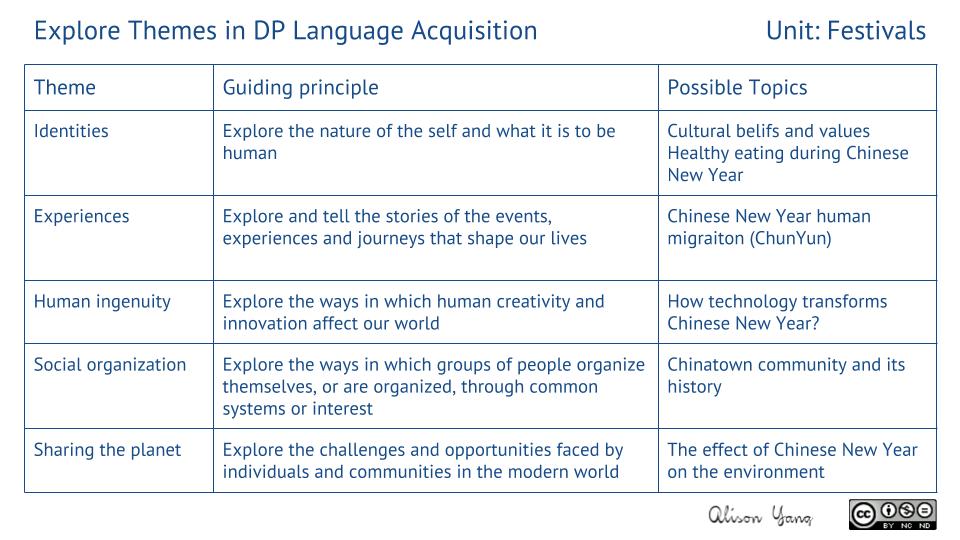
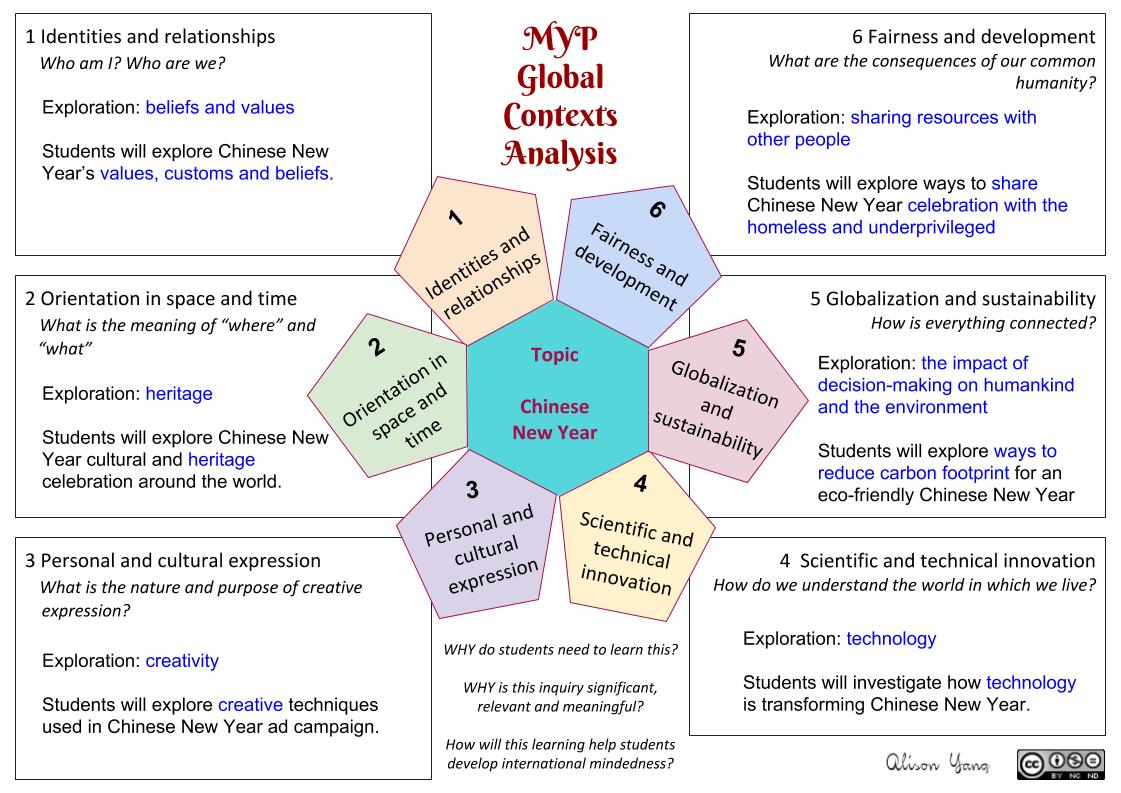
Language acquisition is most effective when students can practice their knowledge and skills through real-life situations. The MYP Global Contexts and the DP Themes provide relevant contexts and opportunities for students to communicate matters of personal, local or national and global interest. It is important for teachers to identify relevant and meaningful contexts when design language learning units. Depending on a different context, the focus of the unit of work and the selection of texts will also be different. Here are my explorations of the DP themes and MYP global contexts by studying festivals focusing on Chinese New Year.    
Picture
Picture
Examining the assessment objectives closely, it is important for teaches to select materials that enable students to develop an awareness of own culture and enable them to foster intercultural understanding. The importance of developing multiliteracies can not be neglected. In the MYP, students are required to comprehending multimodal texts and in the DP, one of the objectives is for students to understand, analyse and reflect upon a range of written, audio, visual and audio-visual texts. In both MYP and DP, we need to engage students in communication practices in comprehending multimodal texts that involve at least two modes. For example, students might watch a short Youtube video clip and analyse the audio (sound effects) and the visual images. If we consistently implement the multimodal approach for language acquisition teaching and learning, I am confident that students will not only be ready for the DP language acquisition course, but they will also be better prepared to apply their linguistic knowledge, understanding and skills in real life after they graduate from high school. 

You can download this infographic in PDF by clicking on the image below. This work is licensed under a Creative Commons Attribution-NonCommercial 4.0 International License. In short, you can copy, distribute and transmit the work, but you must attribute the work. This work is not for commercial purposes.  
​​
10 Comments

The Voice 

2/4/2015

0 Comments

 
Picture
Credit to KIS Student Council
One of Student Council’s major goals this year has been to showcase and recognize the variety of talent that exists within the KIS community. Last term, the Student Council held the Spirit of the Houses Art Competition to shine the light on all our aspiring artists. This term, Student Council hosted KIS The Voice to give an opportunity for all the great singers of KIS to hit the stage."

The Voice was a deeply powerful experience that left us deeply impressed by the talent of the students of KIS. Many students, who had never before had the opportunity to sing on stage at the school, to present themselves and showcase some unexpectedly powerful voices. It was truly inspiring to see young students step up to the stage and sing beautifully into the microphone as the entire school cheered them on. 

And so The Voice became an event where the whole school was able to unite together to support its aspiring singers. KIS will for a very long time remember this inspirational, memorable competition. And for some, I believe, the theme song of The Voice will have taken on a whole new meaning. It is no longer simply a tune used to introduce some reality game show; it is now an anthem for inspiration and spirit. 

"This is the Voice!" 
Recently, student council at my school, KIS International School (KIS), just organized an event called "The Voice" to encourage good singers of KIS to share their talents. I was truly amazed how the event was so well-organized by the student council and excited to see students showing their interest out of academic context. It was absolute a memorable experience to witness when students took initiatives and were empowered, they became creative thinkers and problem solvers. The student council had organized the whole event independently with a supervisor's guidance, including communicating with the school, finding coaches, advertising, recruiting, organizing logistics, and so on. One might wonder what the purpose was and how this related to student learning.

Here is a short write-up by my student, Ken Lohatepanont, who is one of the student council member: 
To conclude, I think it is so important to see students outside of classroom setting from time to time. There was one student who rarely talks in the class and it was such a surprise for her teachers to see and hear her singing with confidence on the stage! As teachers, we must not neglect students' talents and interests! Kudos to KIS student council for organizing a creative and inspiring event that brought the school community together!
Here is the video of the KIS "The Voice" final winner. 
0 Comments

Comprehensible Input vs. Comprehensible Output

28/4/2014

2 Comments

 
The topic for #langchat on Twitter was regarding 'comprehensible input' last Friday, April 25. Lots of discussions were generated. Practical strategies and insightful ideas were shared. The topic was later expanded to 'comprehensible output' and brought out more discussions. Read summaries here: http://goo.gl/zAkgq5

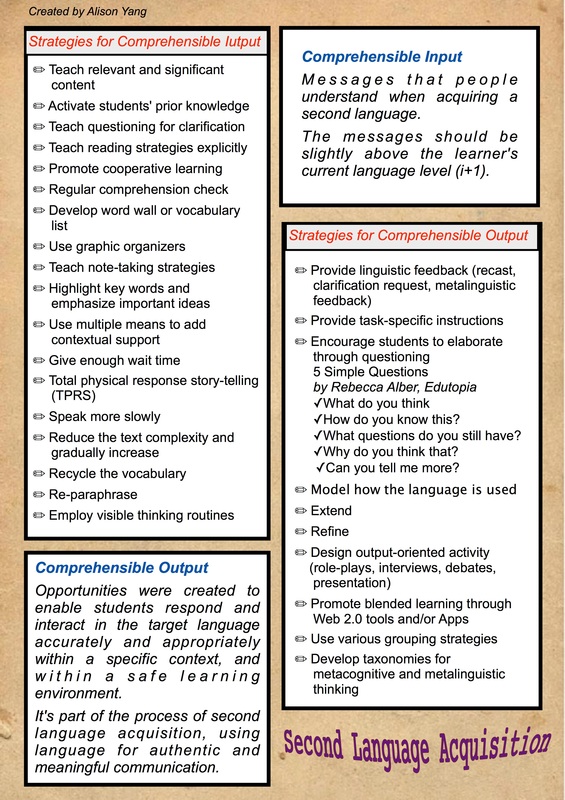
As Dr. Stephen Krashen stated that comprehensible input refers to messages  that people understand when acquiring a second language. The messages should be slightly above the learner's current language level (i+1). According to Krashen's theory of second language, comprehensible input help learners to acquire a second language through meaningful interaction, which is different from learning a second language consciously through formal instrucitons. Many important researchers have clearly identified that second language acquisition can only take place when comprehensible language input is provided and understood by learners. 

Comprehensible output was developed by Merrill Swain. As much as scaffolding is needed for comprehensible input, equal opportunities should also be created in order to develop students' ability to respond and interact in the target language accurately and appropriately within a specific context, and within a safe learning environment. It's part of the process of second language acquisition, using language for authentic and meaningful communication. According to Swain, there are three functions of output: (1) the noticing/triggering function; (2) the hypothesis-testing function; (3) the metalinguistic (reflective function).  The notion of negotiation of meaning plays an important role to explain this theory. Just as toddlers develop their language, they initially receive comprehensive language input and after receiving correct linguistic feedback through positive give-and-take interaction, they then begin to produce the language that can be understood.  

In order to investigate this topic more in depth, I have came up with some guiding questions:
  • How can teachers adjust the delivery of instruction to enable students to achieve higher level of fluency and accuracy in the target language? 
  • As teachers, how can we make input comprehensible so that we allow students to access  meaning? 
  • How can we plan lessons incorporating anticipated language needs that enable students to tackle the demands of the curriculum?
  • What are the strategies that we can use for comprehensible output?  

We have to bear in mind that comprehensible input is NOT equal to simplified instruction. It doesn't mean that we always have to use lower-level vocabulary and grammar structures to help students understand the content. As mentioned above, the messages should be 'i+1' (Krashen).  Additionally, in my opinion, teachers need to take an apprenticeship approach to help students develop language skills at higher proficiency levels, that can be clearly understood by native-speakers. Comprehensible input and comprehensible output should be emphasized with balance and work hand in hand for an effective language acquisition process. 
Picture
2 Comments

    αℓιѕση уαηg

    IB Educator, Learner, Workshop leader, Conference presenter, Educational graphic designer  
    Write to share and reflect! 

    Tweets by @alisonkis

    Categories

    All
    Assessment
    ATL Skills
    Digital Speaking
    Inquiry
    Mandarin Ab Initio
    MYP Criteria
    MYP Personal Project
    MYP Unit Planning
    PD
    Personal Reading
    Raising Trilingual Children
    Reading Strategies
    Reflection
    Second Language Acquisition
    Technology Integration
    Technology Integration
    Transitions

    RSS Feed

Powered by Create your own unique website with customizable templates.