αℓιѕση уαηg
  • Home
  • About
    • Contact
  • Blog
  • Approaches to Learning Skills
    • ATL Skills Posters
  • MYP Interdisciplinary Unit
    • IDU Introduction
    • IDU Planning Process
    • IDU Assessment
    • KIS 19-20 IDU Topics
  • Personal Project
  • Resources
    • Chinese language
    • Research Tools
    • Visual stimulus
    • Web tools & Apps

Book review: The 8 Hour Action Plan

22/8/2019

1 Comment


The 8 Hour Action Plan written by Aloha Lavina provides a guide for school leaders to create an action plan for an evaluation or authorization (accreditation) more productively and efficiently. Anyone who has involved with the school evaluation and/or authorization process would agree in unison that the process is draining and uninspiring. The stress and fatigue is probably also due to the fact that many schools wait till the final year of an accreditation/evaluation year and rush to get everything ready for the visit. Aloha's observation, "It seems that everything stops and nothing else exists but the self-study surveys, meetings, documentation reviews, more meeting.", illustrated exactly what I had experienced in my last preparation for the MYP evaluation! 

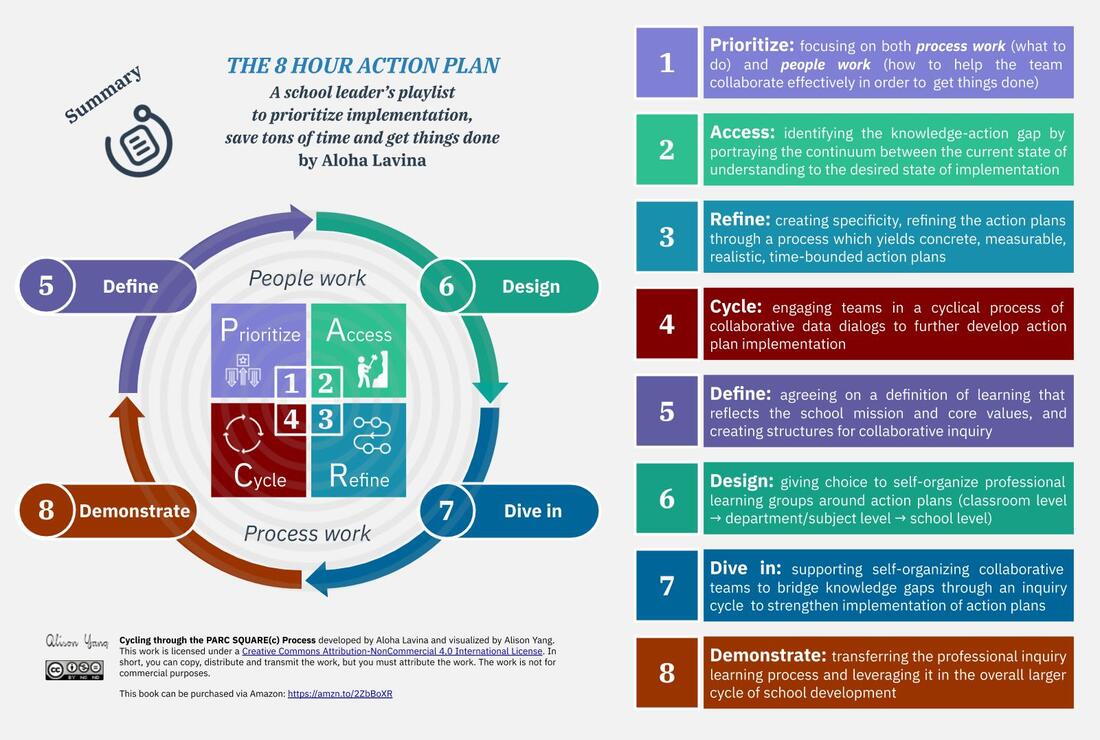
Aloha explained how to chunk this monstrous task, creating an action for the evaluation or authorization, using the PARC SQUARE(c) Framework that she has created. The book was organized into two parts. The first part of the book explains how to use PARC in the process of developing the implementation action plan. 

According to Aloha, PARC represents: 
  • Prioritize (finding the must-haves)
  • Access (removing barriers)
  • Refine (specify the actions)
  • Cycle (iterate the process). 

Here is my summary of the PARC acronyms: 
  • Prroritize: focusing on both process work (what to do) and people work work (how to help the team collaborate effectively in order get things done) 
  • Access: identifying the knowledge-action gap by portraying the continuum between the current state of understanding to the desired state of implementation 
  • Refine: creating specificity, refining the action plans through a process which yields concrete, measurable, realistic, time-bounded action plans 
  • Cycle: engaging teams in a cyclical process of collaborative data dialogs to further develop action plan implementation
"The idea of the 'square' is the fact that if you create this four-zone pattern in your school process, and repeat it as a cycle, you will create a way to exponentially increase your time and results.
The second part of the book expands the PARC SQUARE Framework into a five-year implementation plan. It focuses on creating structures that optimise time and energy and engage professional collaborative inquiry learning in the cyclical process that serves to enact the implementation action plans.   
  • ​Define: agreeing on a definition of learning that reflects the school mission and core values, and creating structures for collaborative inquiry.  
  • Design: giving choice to self-organize professional learning groups around action plans (four-layer professional development structure: classroom level → department/subject level → school level )
  • Dive in: supporting self-organizing collaborative teams to bridge knowledge gaps through an inquiry cycle  to strengthen implementation of action plans  
  • Demonstrate: transferring the professional inquiry learning process and leveraging it in the overall larger cycle of school development 
I have illustrated the PARC SQUARE Framework based on my interpretation. 
Picture
I find the PARC SQUARE framework insightful and useful. It is an important reminder that why schools should value collective intelligence and use it for capacity building. As an educational institute, time and energy are finite resources, and if we can create a system to support development, professionally and emotionally, we not only improve the organization but also create opportunities to foster agency and professional identities.

This book goes beyond merely writing an action plan for the sake of writing an action plan. Instead, it demonstrate system thinking and provides tools and strategies for school leaders to plan, implement and support professional inquiry groups in their school. The concepts of 'process work' and 'people work' resonate with me the most. In order to achieve the success of teams in action planning and implementation, we need focuses on both "what do do (process) and how to help the them (people work) get things done".   ​

I find this book helpful not just for action planning and implementation for the purpose of a school evaluation or authorization. Most importantly, it provides a framework of how school leaders can guide their team to prioritize areas for development and implement the action plan through self-organized professional inquiry leanring groups. If schools are thinking about initiating a new project, implement a new program, promoting the use of a new resource, or taking their team to develop school development plan, the PARC SQUARE suggested in this book is a good framework to follow. Many stories and case studies are shared in this book, which help readers make connections with their own situations and provide ways for them to 'see', 'feel' and 'hear' how the framework is actually used in different contexts.  

Lastly, I do, however, think 8 hours to create an action plan appear to be ambitious. In my opinion, it is more like 8 steps for action planning and implementation. The idea is that if we can use time and energy with intentionality and design a cyclic process of professional collaborative inquiry, then it is more likely we will achieve success for school development in a more sustainable manner. Although it's not 8 hours for me, but it is definitely time saving.  
1 Comment

Better Conversations: note-taking and reflection

1/5/2019

0 Comments


Better Conversations by Jim Knight 

I have been enjoyed reading Jim Knight's books relating professional learning and instructional coaching. His books were well-structured and easy to follow. He often provides concrete examples and useful practical strategies to implement coaching conversations. This blog post records my visual notes and personal reflections from Jim Knight's work, Better Conversations, published in 2016.    

Habit 1: Demonstrating empathy
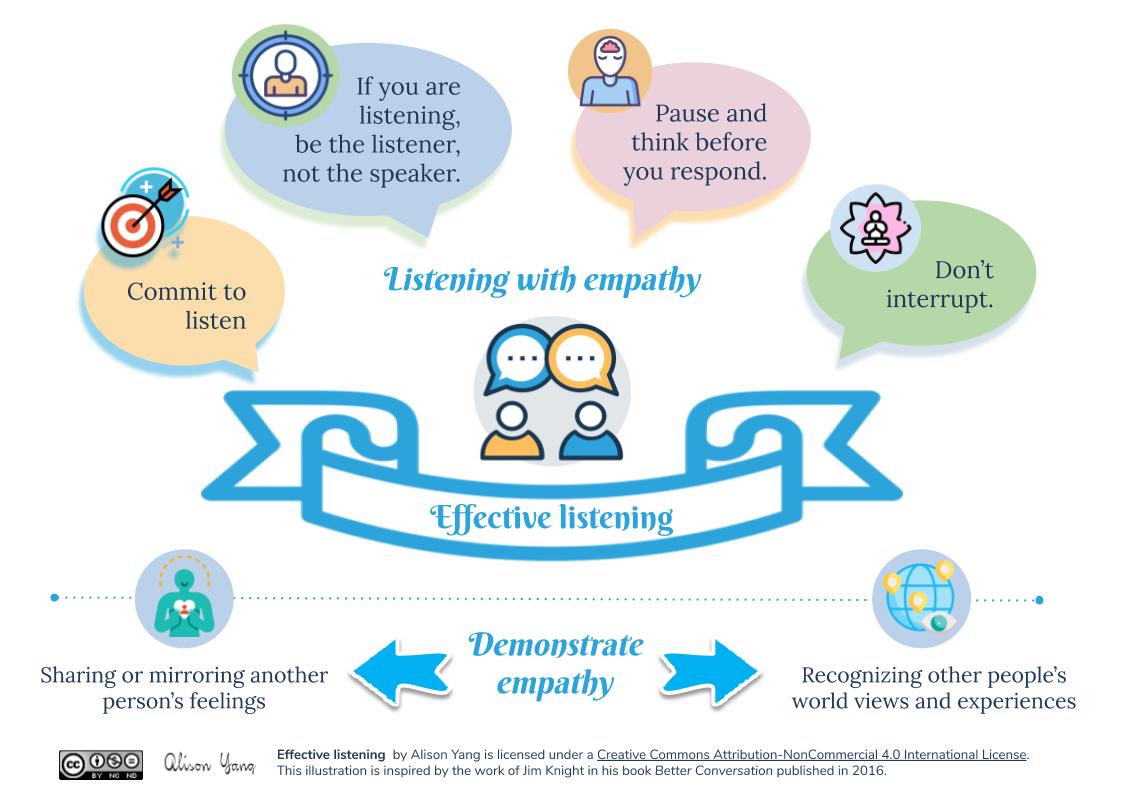
​Habit 2: Listening with empathy 

Before we can listen with empathy, step one is to demonstrate empathy. This can be practiced by "sharing or mirroring another person's emotions", and "making imaginative leap and recognizing that other people have different tastes, experiences, and world views than our own."   

Listening with empathy, the idea sounds easy, but it is very challenging to adhere to this principle in a conversation. We often have to make decisions under pressures at school. If decisions are not made, that often means another meeting, and finding a common time to meet during the school hours is not always easy. I sometimes find myself multitasking on my computer when the topic was not relevant to me in a meeting. I was also sometimes eager to present my ideas and opinions, being conscious of the time, and interrupted other people's thoughts. I do think this is rude and shows my lack of respect to others.  I want to work on this and practice on being an effective listener. I want to remind myself of the importance of pausing in a conversation and listening without judgement in order to understand other people's world views. Jim knight provides four strategies to become an effective listener in his book.
Picture

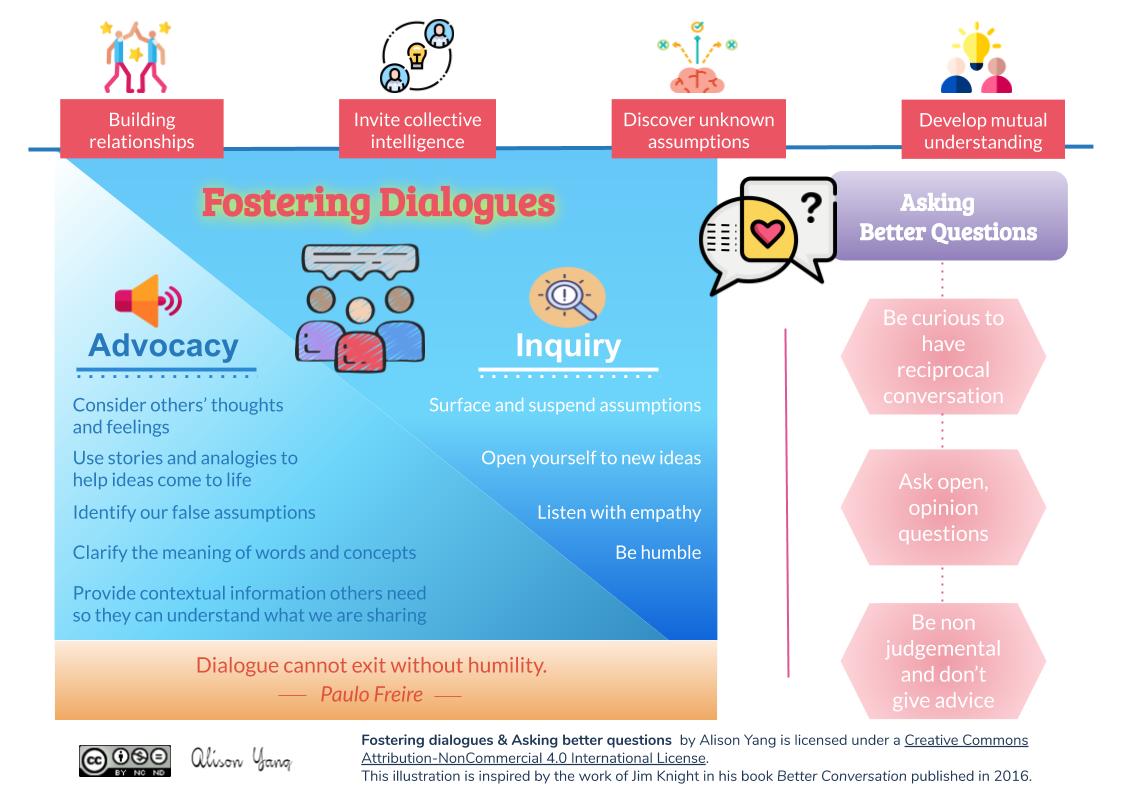
Habit 3: Fostering dialogue 

Dialogue is not going to occur without asking effective questions. The two habits go hand in hand. When reading books relating to cognitive coaching, the definitions of dialogue are often deeply explored. In this book, Better Conversations, the author explained that dialogue is a learning conversation, in which participants listen with empathy and they respect and encourage others' views. The most important idea for me is Paulo Freire's idea (1970) that "dialogue cannot exist without humility."
Fostering Dialogue, we humbly let go of the notion that there is only one right answer⎯our answer!⎯and instead, we choose to see conversation as a testing ground for ideas. A dialogical conversation is something we co-construct with others so everyone in the conversation can learn and grow.    
The reminds me of what's mentioned in The Adaptive School. "Dialogue honors the social-emotional brain, building a sense of connections, it connects us to our underlying motivations and mental models. This way of talking forms a foundation for coherent, sustained effort and community building. In a dialogue we hear phrases like: 
  • An assumption I have is...
  • I'd be curious to hear what other are thinking about this issue." (Garmston and Wellman, 2016) 
​
Simply put, in dialogue, interlocutors who hold equal status take time to listen to other voices and possibilities. It's an opportunity for us to invite collective intelligence, build relationships, and engage intentionally to achieve mutual understanding. It's a caring behaviour. Our assumptions, however, often prevent us from having dialogue. They reflect our worldview, emotions, moral perspectives, culture, and beliefs. Once our assumptions are challenged, we feel threatened and activate our fight-or-flight response. Therefore, dialogue is also a process for us to discover our unknown assumptions. 

The author explained that we can foster dialogue by balancing advocacy and inquiry. As stated in the book on page 78: 
  • Advocacy means speaking what you think, speaking from a point of view. 
  • Inquiry means looking into what you do not yet understanding, or seeking to discover what others see and understand that may be different from you point of view. 
"Balancing advocacy and inquiry means stating clearly and confidently what one thinks and why one thinks it, while at the same time being open to be wrong. It means encouraging others to challenge our views, and to explore what might stop them from doing so." 

This highlights the benefit of using protocols to encourage participants in sharing their voices and ask questions to clarify, probe, and reparaphrase. 

​Habit 4: Asking better questions

To build relationship though dialogue, we ask better questions. Through questions, we listen other ideas and opinions which is a way for us to understand other people's worldview, and discover our own assumptions. 

I made a close connections with Bréne Brown's Dare to Lead. In dialogue, we need to prepare to be wrong and embrace our fear, and have courage to ask better questions. She created a cheatsheet to show one can be brave and keep their mind open for productive conversations in her blog post, Let's Rumble. I personally found this cheatsheet very useful. ​
The missing ingredients in most conversations are curiosity and willingness to ask questions to which we do not already know the answers. (Edgar Schein)  
Picture

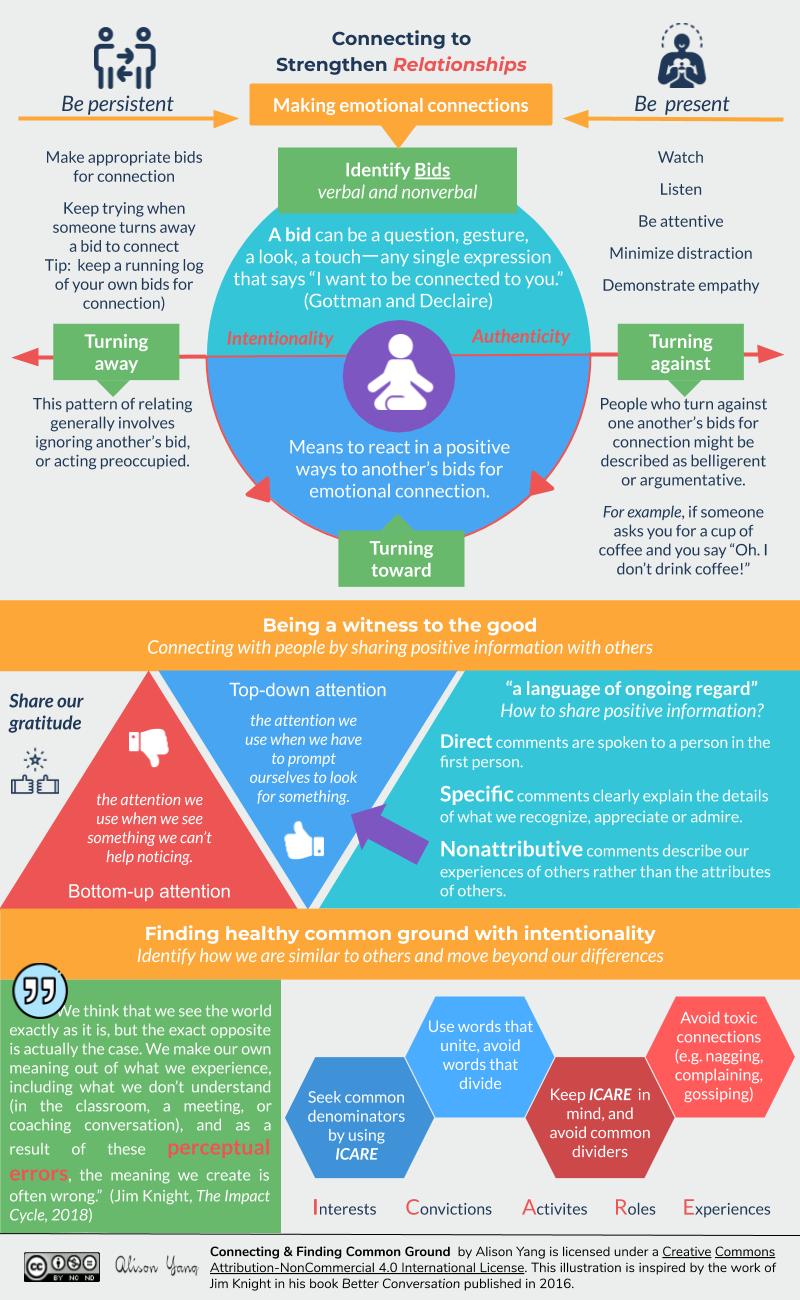
Habit 5: Making emotional connections 

If we want our relationships to flourish, we need to reach out to connect by responding positively to the bids received (turning toward). By the same token, we also want to express our bides to others in order to make connections to the people we care. In this process, we pay attention to verbal (e.g.a question, an invitation, a response...) and nonverbal bids (e.g. a smile, a hug, a gesture, a physical touch...). To practice this habit, we can observe how people interact with these bids. As the book mentioned, this strategy is best practiced by sitting in the coffee shop for people watch. Have our eyes, hears and heart open and pay attentions to subtle verbal and nonverbal communication.  

Habit 6: Being a witness to the good 

We all like to feel motivated, encouraged, validated, and boosted when we hear positive comments about the word we do. I think being a witness to the good is one way for us to show our gratitude and respect to other people. When sharing positive information with others, we do have to be mindful of the language we use; otherwise, our comment will sound phony. Show our appreciation through detailing our experiences with them by using intentional language. In terms of sharing positive information with others, where do we start? We make an effort to find strength of others and keep a journal to record what positive behaviors observed. For example, at KIS, our staff participate in What Wonderful Work (W.W.W). Toward the end of each term, teachers write to nominate their thankfulness and appreciation to colleagues they have interaction with.    

Habit 7: Finding common ground 

To start a connection, we can also focusing on finding healthy common ground. I found the acronym ICARE (Interests, Convictions, Activities, Roles, and Experiences) is easy to remember and provides good entry points to find the common ground. I think this is also a way to show others that we want to get to know them and hear their interesting stories and experiences. Having identifying the common ground, it is easy for people to identify the similarities and differences. It's provide an opportunity for us to hear stories and worldviews of others. 
Picture

Reference:

  • Garmston, Robert J., and Bruce M. Wellman. The Adaptive School: a Sourcebook for Developing Collaborative Groups. Rowman & Littlefield, 2016.​​
  • Knight, Jim. Better Conversations. ​Crown A Sage Company, 2016.
  • Knight, Jim. The Impact Cycle: What Instructional Coaches Should Do to Foster Powerful Improvements in Teaching. Corwin, A Sage Company, 2018.
0 Comments

    αℓιѕση уαηg

    IB Educator, Learner, Workshop leader, Conference presenter, Educational graphic designer  
    Write to share and reflect! 

    Tweets by @alisonkis

    Categories

    All
    Assessment
    ATL Skills
    Digital Speaking
    Inquiry
    Mandarin Ab Initio
    MYP Criteria
    MYP Personal Project
    MYP Unit Planning
    PD
    Personal Reading
    Raising Trilingual Children
    Reading Strategies
    Reflection
    Second Language Acquisition
    Technology Integration
    Technology Integration
    Transitions

    RSS Feed

Powered by Create your own unique website with customizable templates.