αℓιѕση уαηg
  • Home
  • About
    • Contact
  • Blog
  • Approaches to Learning Skills
    • ATL Skills Posters
  • MYP Interdisciplinary Unit
    • IDU Introduction
    • IDU Planning Process
    • IDU Assessment
    • KIS 19-20 IDU Topics
  • Personal Project
  • Resources
    • Chinese language
    • Research Tools
    • Visual stimulus
    • Web tools & Apps

Develop ATL skills through the MYP personal project

4/9/2021

4 Comments


What is self-regulation? 

According to Pintrich and Zusho (2002), self-regulated learning is an active constructive process whereby learners set goals for their learning and monitor, regulate, and control their cognition, motivation, and behaviour, which is guided and constrained by their goals and the contextual features of the environment. The MYP Personal Project provides a great opportunity for students to develop self-regulation and metacognition which prepares them not only for the DP study but also lifelong learning.

In the context of the MYP personal project, self-regulated learners exercise their agency; set personal learning goals to acquire knowledge and skills; demonstrate their consolidation of their learning through making a product. Throughout the personal project making process, students identify and practice strategies to develop their approaches to learning skills and make strategic steps to achieve their personal project goals. In the process of completing their personal project, they monitor their engagement, reflect on what worked and what did not work, and make adjustment of their actions accordingly. In order to achieve the desired outcomes, students will need to identify what approaches to learning (ATL) skills is needed and what a new learning strategy is effective to help them achieve their goals. I think this is where students can benefit greatly from the supervisor's guidance. We should not assume that MYP Year 5 students have all the necessary skills and learning strategies. The conversation about what skills might help you (the student) in achieving the learning goal(s) and product goal(s) must be deliberate. Although they are MYP Year 5 students, it doesn't mean all their subject teachers have explicitly taught them ATL skills and provided them with specific strategies to develop particular ATL skills.  

Personal Project Objectives & ATL Skills (2021)

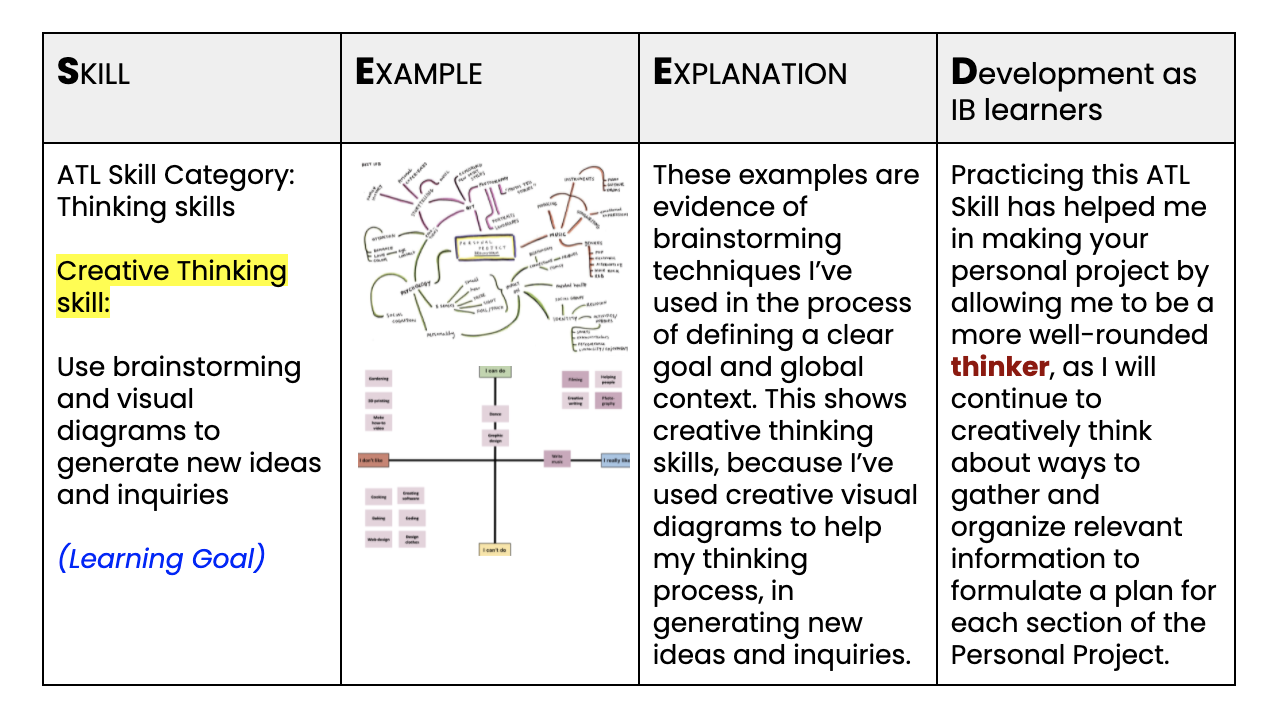
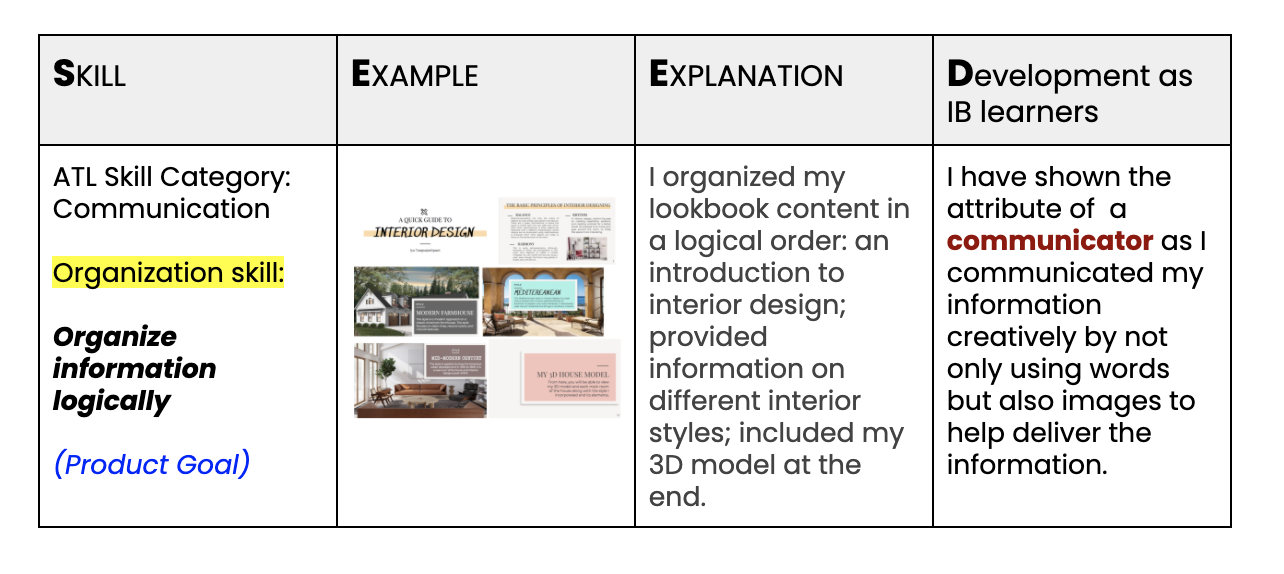
In the new MYP personal project guide (2021), students select the most appropriate ATL skills for each stage of their project. Previously, students were required to demonstrate specific ATL skills specified by the MYP at each stage of the process. I believe this new change will further empower students to monitor and control cognition, motivation and behavior in order to achieve their personal project goal. In the student-supervisor meetings, it's is important to ask students in each stage about what skills they would like to apply or practice in order to reach their goal. Help them to visualize what it looks like when they demonstrate the skill and what example might be included. Even better, guide students to elaborate what IB learner profile attribute they will be demonstrating by applying a specific ATL skills.   

Here are some examples of how ATL skills might be applied in different stages of completing the personal project: 
In the planning phase: 
Picture
In the process of making the product: 
Picture

Here is the poster that I have created to support the student-supervisor conversation. Click the image to download the PDF version.

References

  • Pintrich, P. R., & Zusho, A. (2002). The development of academic self-regulation: The role of cognitive and motivational factors. In A. Wigfield & J. S. Eccles (Eds.), Development of achievement motivation (pp. 249– 284). San Diego, CA: Academic.
4 Comments

Design thinking in MYP personal project

23/4/2019

0 Comments


What are students getting out of the personal project?

I enjoy tremendously in supporting students in completing their MYP personal projects. Through the process of completing a personal project, I feel the biggest growth that students develop is GRIT. The MYP personal project is essentially a design challenge that engages students in the process of ideation, prototyping and testing the viability of their ideas. This kind of experimental iteration allows students to exercise their agency, ownership, and entrepreneurship. It is an inspiring inquiry cycle that allows students to stretch their learning capacities and capabilities through the guidance of experienced adults. Throughout the process, not only their intellectual curiosity is satisfied, but they also become grittier. Students constantly encounter failures and they need to come up with solutions to fix their obstacles in order to make their project. Meanwhile, they also need to learn how to manage their time in completing their other assignments and duties. It can be a very stressful process for some students. I want to highlight the perseverance and resilience that students have developed through this trial and error process in making their personal project, and this is not something that can be measured quantitatively. We need to help them to recognize and celebrate their potential. It is paramount that we guide them to understand how becoming grittier can help them succeed later in their life.     
Picture

How can we involve them and celebrate their success? 

After finishing making their projects, students showcase their project/outcome in the MYP personal project exhibition. It is an opportunity for them to share their learning process and tell their stories. It is a story that tells how they develop courage, embrace vulnerability, make connections and seek meaning. All supervisors knew it is far more than just completing a product or achieving an outcome. I want to scaffold students to explain the process they go through in detail when they share their projects with the audience in the exhibition. When the audience walks away, they will appreciate students' perseverance and recognize their bravery in completing their project. 

2015-16
Three years ago, when I was the personal project coordinator, I asked my students "How are you going to tell your story in the exhibition?" They did not quite understand what I meant. In the previous years, students presented their project in the exhibition and often the focus was on the product rather than the process. Students introduced what they made but they did not always market their story and connect with the audience emotionally. 
 
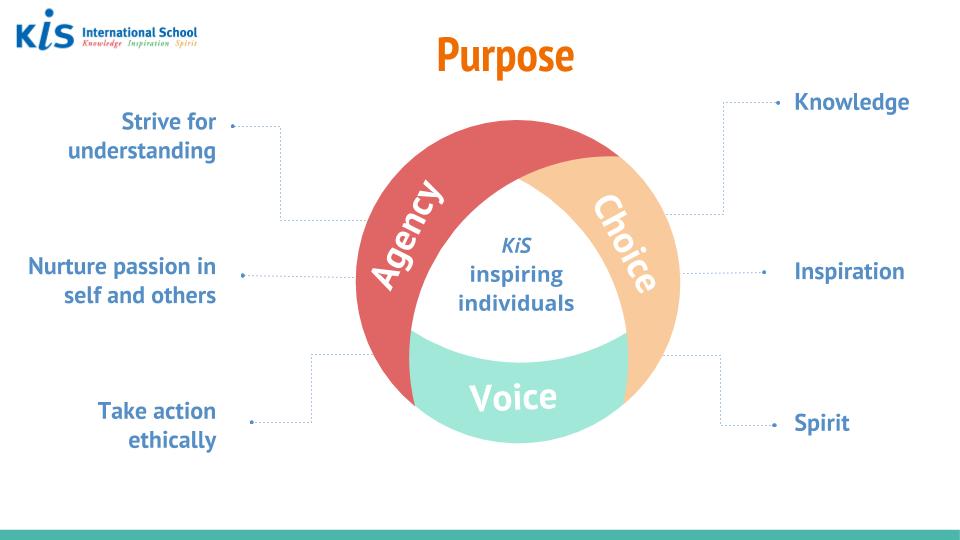
At KIS, our vision is inspiring individuals. Our aim is to inspire individuals, while we hope that our students and other members of the community in return can go out into the world and inspire others. I feel the exhibition is a perfect opportunity for students to inform, educate and/or inspire the audience. To help students visualize how to share their story more effectively, I share Jake Andraka's TED talk with students (00:00-01:54).       
We focused on the first two-minute of his storytelling and examined how Jack shared with the audience his project. So, viola! Students in that year presented their story in TED talk style and everyone curated their story for a two-minute talk or less. Some students did not feel comfortable talking on the stage, they made a video to share their project. The audience responded positively and students felt so proud of themselves. I reflected on the way I supported students. Students were more actively involved with the planning, but I knew there was not enough agency, choice, and voice. 
2016-17
The first year I did not really know what I was doing. I only knew that I would like to create an opportunity for students to inspire others and for the audience to have an insight of the personal project process. The second year, I asked the students again, "How are you going to tell your story?" Students who had attended the previous exhibition, and this cohort did not want to give a speech. So they organized themselves into different committees and created job descriptions to plan for their exhibition. I was truly amazed. Then I asked them how they were going to advertise the event. They created a promotional poster and 6-word memoir video to invite people to visit their exhibition. Next, we discussed how the exhibition should be organized and how the audience might interact with the presenters and the exhibition space. Students took one step further and they came up with an exhibition theme, accompanying with a floor plan and a brochure to introduce the presenters. They also selected MCs to host their own events and curated a music playlist for the exhibition. I reminded them that a good exhibition requires rehearsals. They wrote key ideas about what they wanted to share with the audience and they rehearsed with each other a couple of times before the exhibition. It was an excellent exhibition and students developed an ownership of this event. Working with this group of students, I experienced the power of providing students choice and voice, which are the two important ingredients to develop student agency and therefore develop inspiring individuals.  
Picture
Here are some exhibition planning artifacts of the 2016-17 class.  
2017-18
Having seeing the great exemplar, students followed similar process and forming their task force teams. The theme that students decided on was Metro. They used different subway lines to represent six different global contexts. There were several artists and designers in this chord, and they even decided the color scheme for their exhibition. The video students made was excellent and captured the essence of the personal project. The audience were so impressed and one of the parent who worked for Dior actually awarded internship opportunities to two students! 
2018-19
Students keep raising the bar. The theme students decided on was Monopoly. The reason that students had chose the Monopoly theme was because they felt the personal project itself is a game of wit and tack, and also filled with opportunities popping up left and right. Sometimes, it also felt like being in jail. The teams had worked together to plan and curate their exhibition by working out the following: 
  • Music playlist 
  • Monoproject logo 
  • Floor plan 
  • Group equipment & material request 
  • MCs & scripts 
  • Advertising poster 
  • Exhibition brochures 
  • QR codes for their products 
  • Introduction video ​
Individually, students also create a poster to explain their project. We discuss what a good poster look like and how we can use the poster to engage with the audience. 
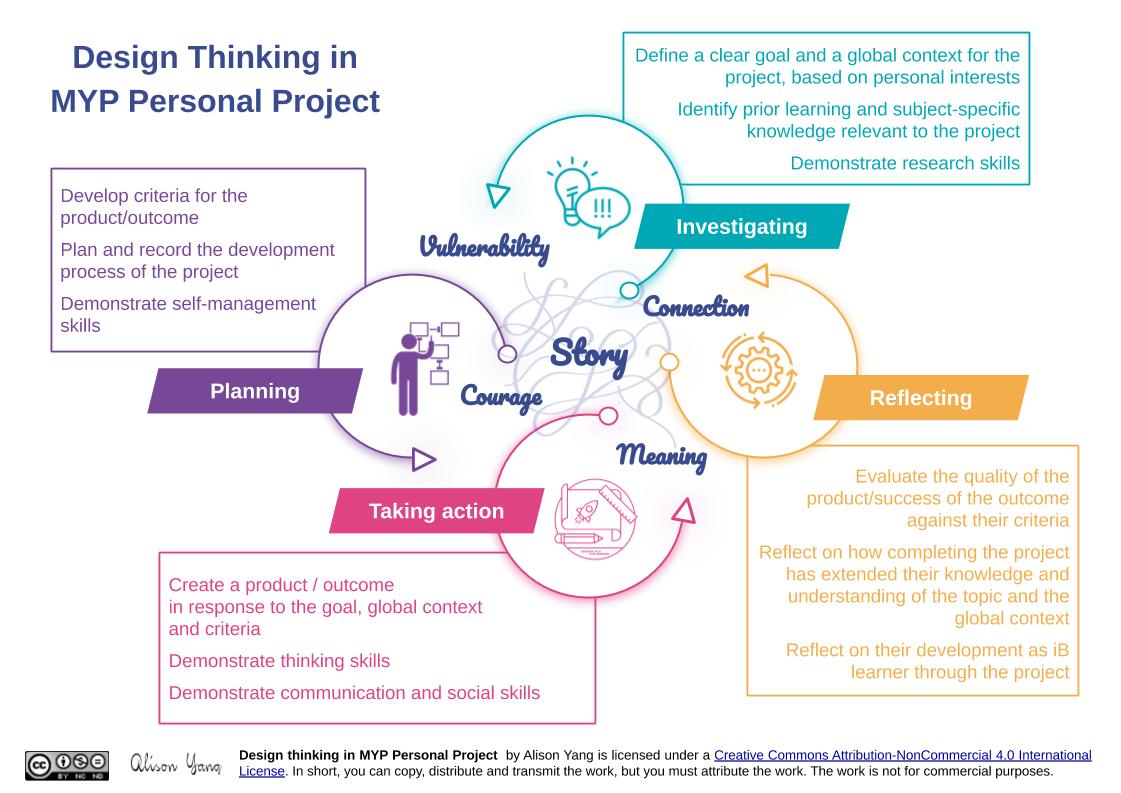
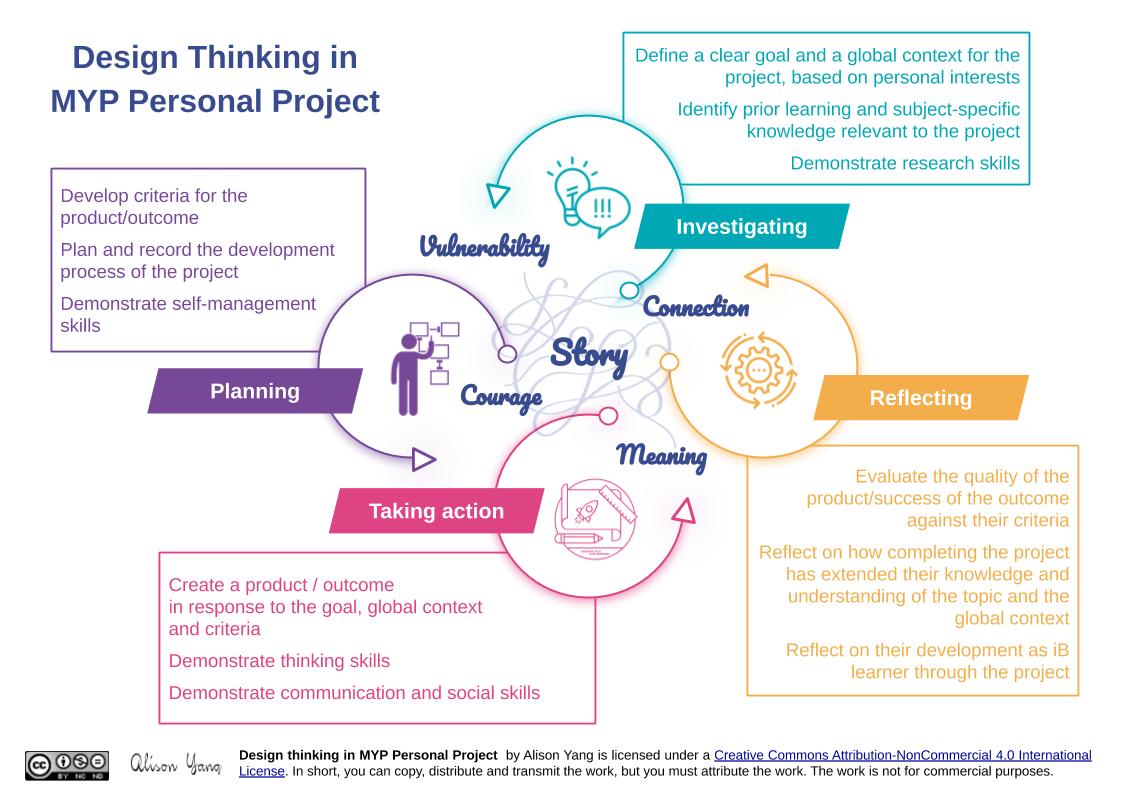
I feel compelled to documented this journey that I have gone through with my students, and look forward to continuing to work with the young adults to make their project and celebrate their achievement by involving them in planing and curating their exhibition. I treat them as designers and I am always amazed what they produced. I told my students that learning does not stop after they complete their personal project. They are encouraged to approach problems and projects by utilizing design thinking as a strategy for innovation. The process of creating a project is messy and starts with stories. Throughout the process, students create their narrative and share how they develop courage, embrace vulnerability, make connections and seek meaning. This type of learning can prepare them for life, but not just for work. I created this diagram to highlight the storytelling process and emphasize design thinking is like an infinity loop, not a straight line, as there is continuity and it is a mindset for life. 
Picture
0 Comments

Create an EPIC goal for the MYP personal project

11/9/2018

0 Comments


EPIC goal setting 

I was taking a video online course conducted by @tonyvincent in July. The topic of the week was how to narrate effectively and we were asked to create a narrated slideshow by using Adobe Spark. I have been working with MYP grade 10 students closely in the past few years to support their personal projects. It seems to me that students usually have troubles in defining their goal and justifying why their goal is challenging to them. It also seems slightly difficult for new supervisors to ask questions and guide students to explain their goals. Therefore, I decided to create a video and made an attempt to explain the process. 

Searching on Youtube, several videos explaining how to set goal for the MYP personal project are either too long or too boring. I took a risk and created something different by following the tips shared in the book, Made to Stick. On a different note, I love all the books written by Chip Heath & Dan Heath. I highly recommend this book to anyone whose job is to communicate information to different audience. When communicating anything, we should keep them: simple, unexpected, concrete, credible, emotional, stories. My instructor, Tony, has added another component, seen, using photos, images, or videos to illustrate ideas. 

I believe stories are important to connect everyone with their emotions and experiences. I decided to use superheroes as main characters to talk about the importance of having a clear goal and devise and implement their action plan based on their epic goal. 

Here is the video I made. There are several things I want to fix if I will make this video again. But I think the guiding principles can guide students to the right directions.

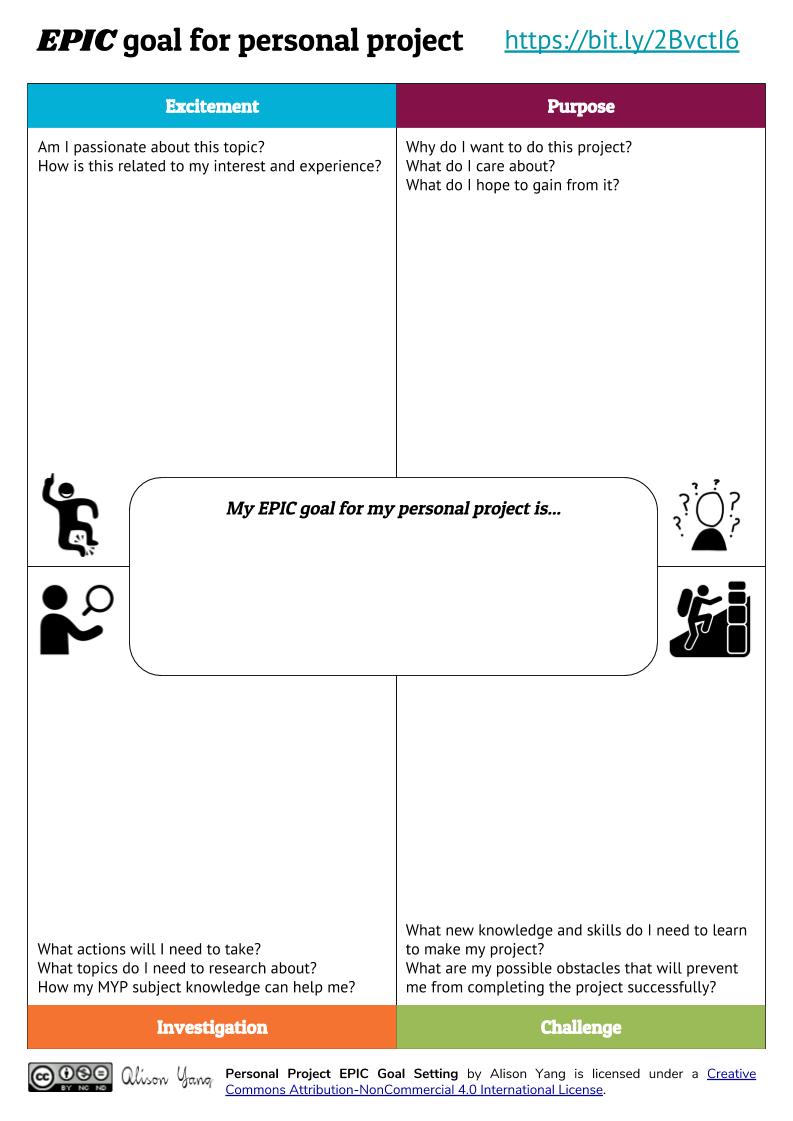
Principles of setting an EPIC goal 

Excitement 
  • Am I excited about this topic?
  • How is this related to my interest and experience?
Purpose 
  • Why do I want to do this project?
  • What do I care about?
  • What do I hop to gain from it?
Investigation  
  • What actions will I need to take?
  • What topics do I need to research about?
  • How my MYP subject knowledge can help me?
Challenge  
  • What new knowledge and skills do I need to learn to make my project?
  • What are my possible obstacles that will prevent me from completing the project successfully? 
The Purpose section of the EPIC goal setting requires students to think about the WHY of their project and pushes them to think about what they actually care about. Students later identify key words from the Purpose section and make connections with the global contexts and explorations. 

I created an EPIC goal setting graphic organizer to guide students and supervisors through the process. This process has received positive feedback from both students and supervisors. Perhaps you will find it useful too. 
Picture
0 Comments

What is my role in the personal project?

25/8/2018

2 Comments


Roles and responsibilities for the MYP Personal Project 

I am very passionate about the MYP personal project as it gives students full ownership of their learning. This is a PROCESS in which students are guided to expand their potentials and encouraged to follow their natural curiosity making their project. They have free choice of topic, concept, content , context, process and product. Each student is paired up with a supervisor to help them stay on track for their goal. Throughout the process, many discussions and dialogues take place to push the student to think and reflect deeper in order to identify their WHY of doing. This is the process in which students have an opportunity to enhance their personal values and beliefs, and develop their own self-identity.

To maximize the success of supervision and student performance, supervisors and students should have a clear view of their roles and responsibilities. After getting ideas from the students and supervisors, and referring to the MYP personal project key documents, I have created this infographic to help us have an overview of what the personal project is, what the three key components and most importantly, what our roles and responsibilities are.   

You can click the image below to download the PDF version of this document or write to me via [email protected] to request an access to this document for reuse or modification. 

Reference

  • “International Baccalaureate Middle Years Programme Subject Brief: Personal Project (From 2014).” International Baccalaureate, www.ibo.org/globalassets/digital-tookit/brochures/myp-brief_personal-project_2015.pdf.
  • MYP: Projects Guide (published 2014, updated September 2017)
2 Comments

    αℓιѕση уαηg

    IB Educator, Learner, Workshop leader, Conference presenter, Educational graphic designer  
    Write to share and reflect! 

    Tweets by @alisonkis

    Categories

    All
    Assessment
    ATL Skills
    Digital Speaking
    Inquiry
    Mandarin Ab Initio
    MYP Criteria
    MYP Personal Project
    MYP Unit Planning
    PD
    Personal Reading
    Raising Trilingual Children
    Reading Strategies
    Reflection
    Second Language Acquisition
    Technology Integration
    Technology Integration
    Transitions

    RSS Feed

Powered by Create your own unique website with customizable templates.