αℓιѕση уαηg
  • Home
  • About
    • Contact
  • Blog
  • Approaches to Learning Skills
    • ATL Skills Posters
  • MYP Interdisciplinary Unit
    • IDU Introduction
    • IDU Planning Process
    • IDU Assessment
    • KIS 19-20 IDU Topics
  • Personal Project
  • Resources
    • Chinese language
    • Research Tools
    • Visual stimulus
    • Web tools & Apps

Develop ATL skills through the MYP personal project

4/9/2021

4 Comments


What is self-regulation? 

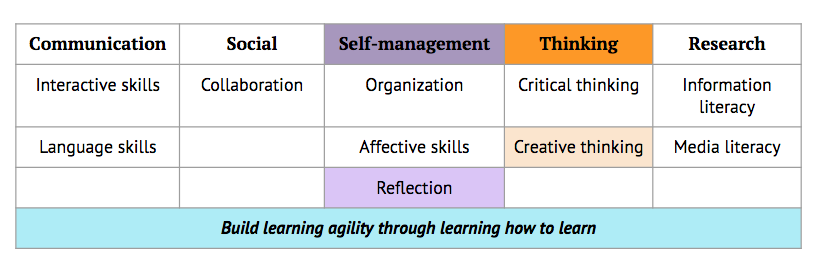
According to Pintrich and Zusho (2002), self-regulated learning is an active constructive process whereby learners set goals for their learning and monitor, regulate, and control their cognition, motivation, and behaviour, which is guided and constrained by their goals and the contextual features of the environment. The MYP Personal Project provides a great opportunity for students to develop self-regulation and metacognition which prepares them not only for the DP study but also lifelong learning.

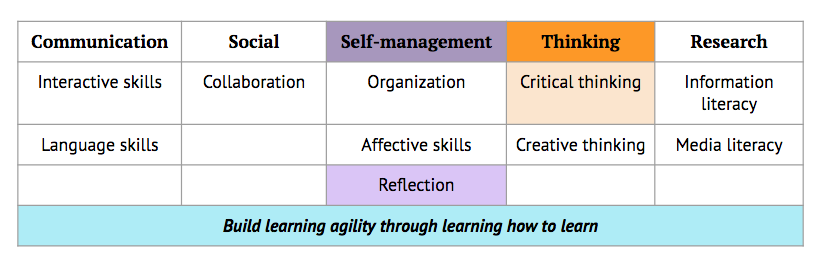
In the context of the MYP personal project, self-regulated learners exercise their agency; set personal learning goals to acquire knowledge and skills; demonstrate their consolidation of their learning through making a product. Throughout the personal project making process, students identify and practice strategies to develop their approaches to learning skills and make strategic steps to achieve their personal project goals. In the process of completing their personal project, they monitor their engagement, reflect on what worked and what did not work, and make adjustment of their actions accordingly. In order to achieve the desired outcomes, students will need to identify what approaches to learning (ATL) skills is needed and what a new learning strategy is effective to help them achieve their goals. I think this is where students can benefit greatly from the supervisor's guidance. We should not assume that MYP Year 5 students have all the necessary skills and learning strategies. The conversation about what skills might help you (the student) in achieving the learning goal(s) and product goal(s) must be deliberate. Although they are MYP Year 5 students, it doesn't mean all their subject teachers have explicitly taught them ATL skills and provided them with specific strategies to develop particular ATL skills.  

Personal Project Objectives & ATL Skills (2021)

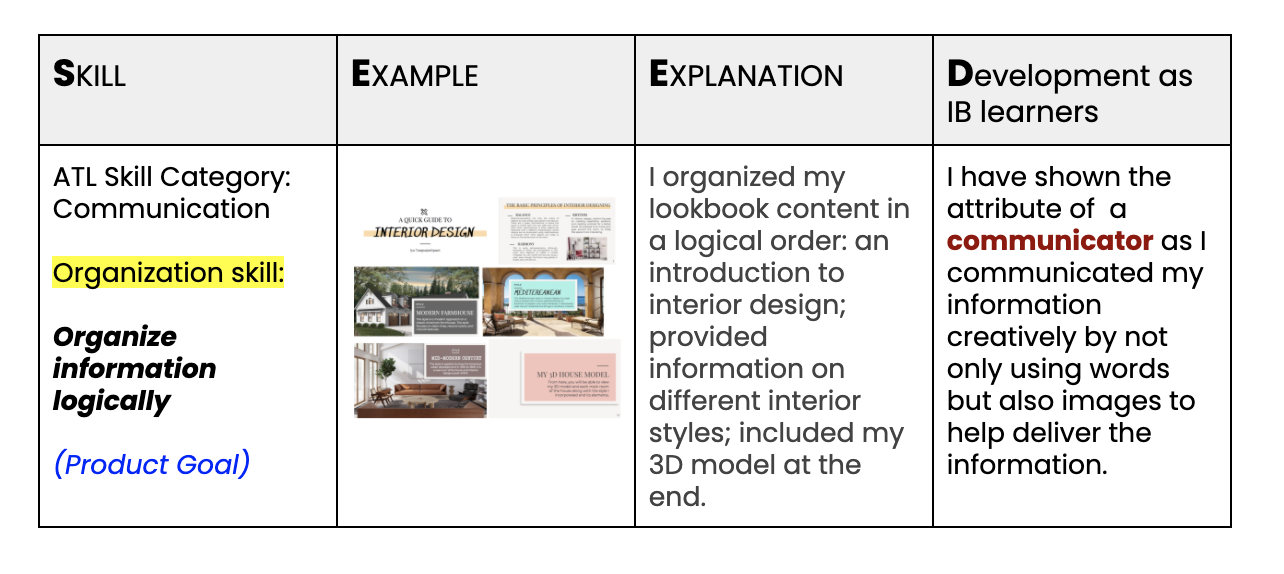
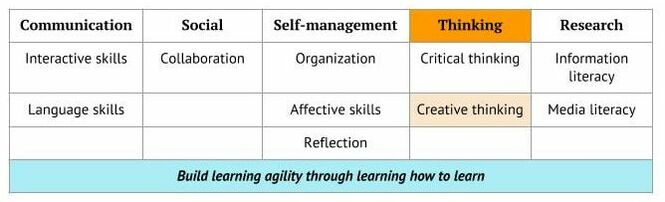
In the new MYP personal project guide (2021), students select the most appropriate ATL skills for each stage of their project. Previously, students were required to demonstrate specific ATL skills specified by the MYP at each stage of the process. I believe this new change will further empower students to monitor and control cognition, motivation and behavior in order to achieve their personal project goal. In the student-supervisor meetings, it's is important to ask students in each stage about what skills they would like to apply or practice in order to reach their goal. Help them to visualize what it looks like when they demonstrate the skill and what example might be included. Even better, guide students to elaborate what IB learner profile attribute they will be demonstrating by applying a specific ATL skills.   

Here are some examples of how ATL skills might be applied in different stages of completing the personal project: 
In the planning phase: 
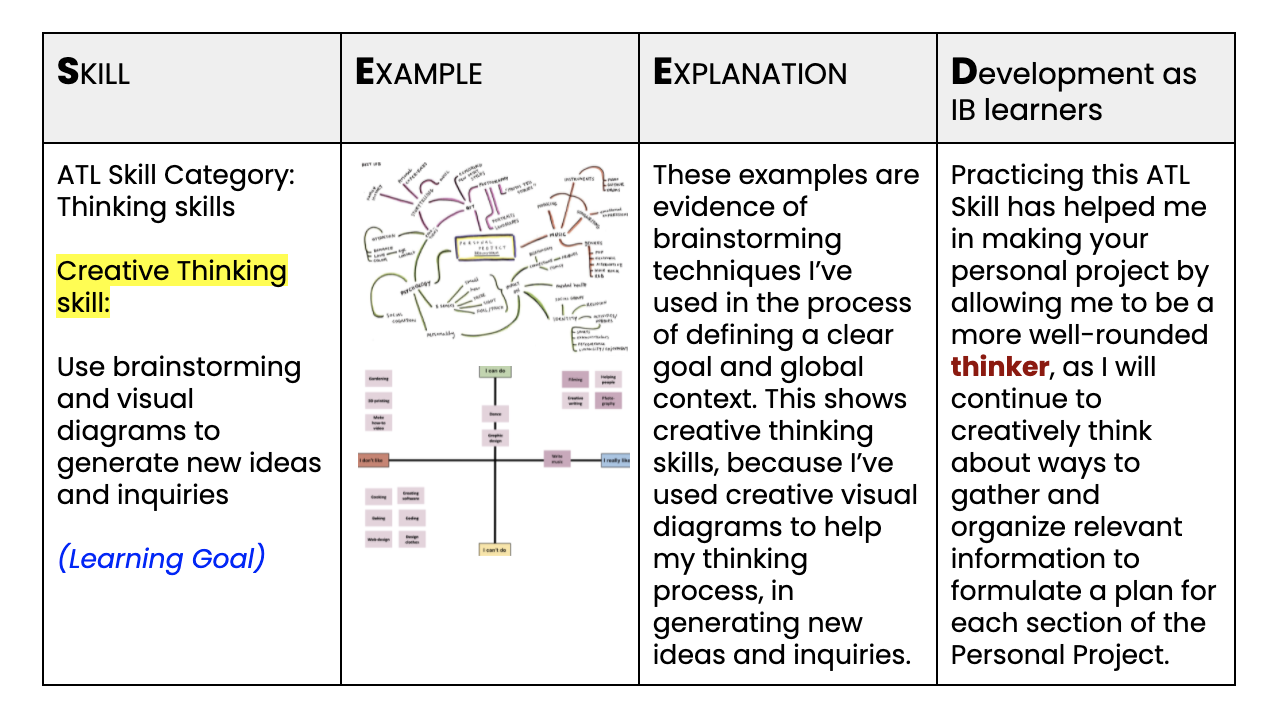
Picture
In the process of making the product: 
Picture

Here is the poster that I have created to support the student-supervisor conversation. Click the image to download the PDF version.

References

  • Pintrich, P. R., & Zusho, A. (2002). The development of academic self-regulation: The role of cognitive and motivational factors. In A. Wigfield & J. S. Eccles (Eds.), Development of achievement motivation (pp. 249– 284). San Diego, CA: Academic.
4 Comments

Analogy prompt

7/3/2019

0 Comments

 
Picture
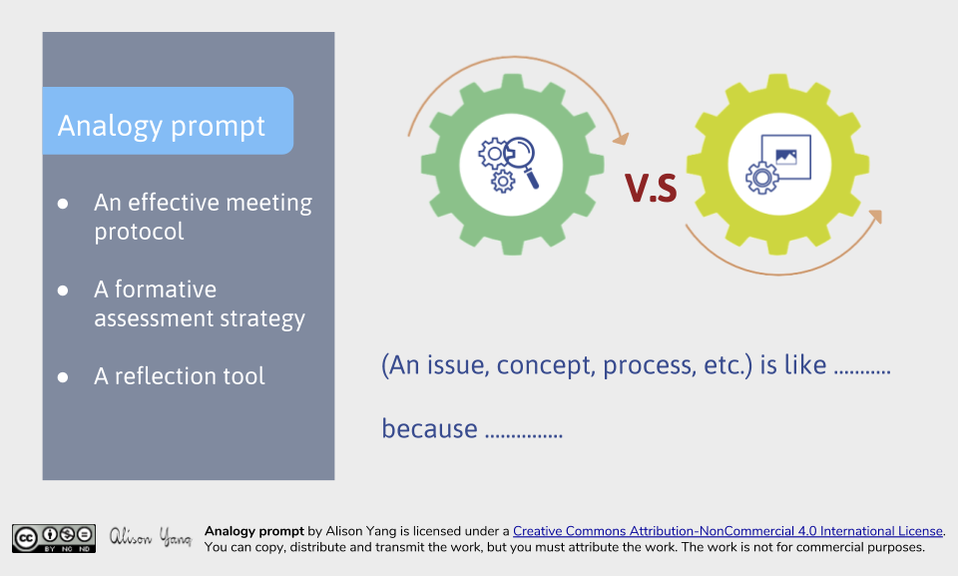
Analogy prompt is a great strategy to help learners make sense of critical information and allow them to paint a picture of an important concept. I like to use analogy prompt in my teaching and teacher training workshops. Everyone comes with different experiences and cultural backgrounds. The use of analogy prompt makes discussion fun; allows learners to connect with their personal experiences in the process of making sense of a new idea or concept being introduced; helps them to visualise their thinking. It has been an effective meeting protocol for me when discussing important issues or ideas with teachers. I encourage my students to use analogy prompt to reflect on their learning process. Reflection doesn't have to be tedious. By making an analogy, it engages learners with deeper thinking. It is also a formative assessment strategy to monitor students' understanding of the concept that is being taught.

​When using this strategy, it is beneficial to provide an example. Additionally, allocating time for individual thinking is also essential. It is always useful to provide learners with a sentence stem. 
Picture
I worked with a group of student teachers from National Taiwan Normal University in October, 2018. I introduced the inquiry-based teaching and learning concept and students were engaged in conducting in an inquiry activity. We also explored different structures of inquiry and discussed the level of scaffolding required for each type of inquiry. At the end of the day, I invited them to consolidate their learning and reflection on inquiry-based teaching and learning by using analogy prompt strategy. These university students were so creative and I can't help to record their thinking in my blog. If you can know Chinese, they are really fun to read. These students had paint a clear picture of what they think inquiry-based teaching and learning is. 
0 Comments

Harness the power of reflection through storytelling

29/11/2018

0 Comments


Curated storytelling as reflection 

Picture
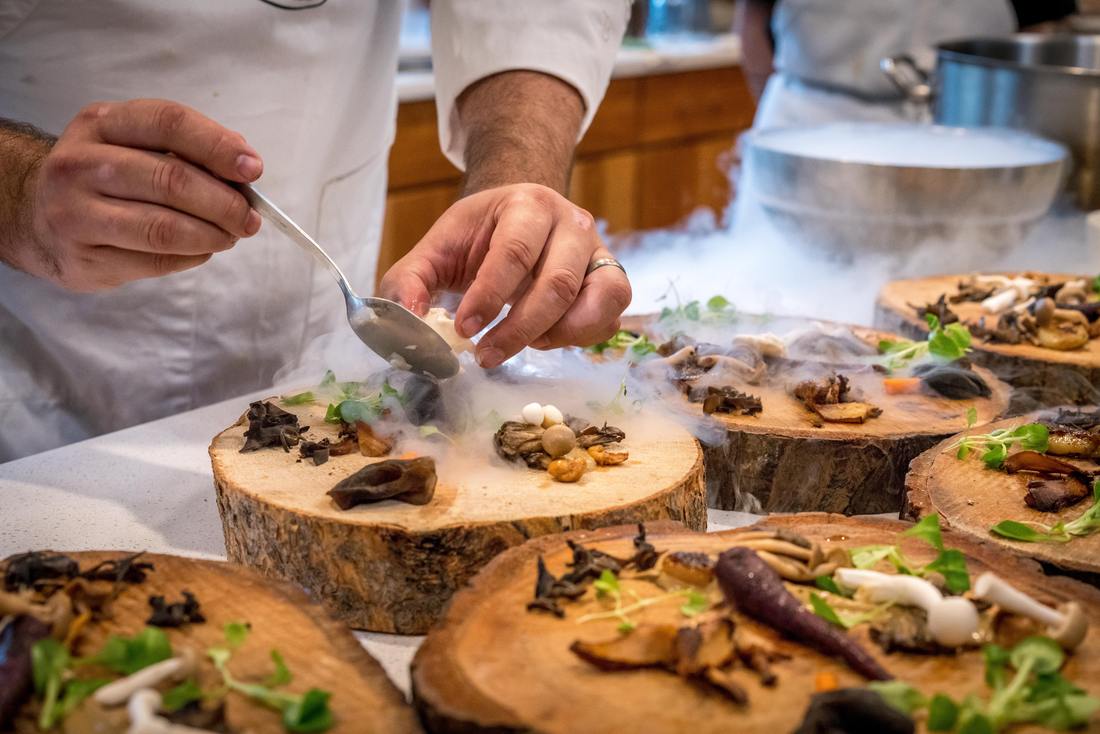
Chef's table, an original Netflix documentary series, is one of my favourite tv show. World's most renowned international chefs are interviewed in the show and they share their journey of being a chef through powerful storytelling. They talk about the trial and error process when crafting their cuisine. They reflect on their childhood and their relationships with people and/or with communities, and how they applied their new understanding in their food creation. Different concepts behind the dishes are beautifully illustrated through their narrative. Through their stories, the audience discover how these chefs make personal connections and find their own identities through their food. I am always inspired by the powerful messages and how concepts are synthesized and succinctly conveyed through their cuisine, through their stories. It's far more than just a dish. It's not just what they do. They care deeply about why they do it and deliberately tell their stories with curation. Through their stories, I've had an epiphany that creative and critical reflection with curation not only leads to innovation, but also identity formation.   

As reminded by John Dewey, the famous American educator and philosopher, "we don't learn from experience. We learn from reflecting on experiences." It is through reflections that we connect dots (linking prior learning with new acquired knowledge, understanding and skills) and make sense of our experiences. It is a powerful way of thinking that helps us develop personal growth in all aspects and enables us to develop confidence and capacity. Examining attributes of successful people in different professional fields, we often identify one common quality that contributes to their success. That is being reflective. Having a reflective mindset has been crucial and will remain paramount for us when generating innovative ideas and solutions in the unknown future. 
 
​Reflection (way of thinking) is a core element of the MYP inquiry cycle and assessed in different subject groups. Reflection requires intension and critical thinking (analyzing, inferencing, explaining, evaluating, conceptualizing). These are the skills that require explicitly coaching and scaffolding. Students are often asked to reflect through question and answer format, written communication or video recording. I sometimes feel that students perceive reflection is time consuming and tedious. If we, teachers as facilitators, are not mindful and intensional, students end up recording superficial random events of what happened but not deeply analyzing the 'how' and the 'why' for moving forward. Another observation is that students often collect 'everything' on their learning portfolio without editing. Instead, students should be taught and have opportunities to practice on how to curate their stories, focusing on quality but not quantity. Through curated reflective practices, students could be encouraged to think as an artist, a photographer, a food critic, a musician, a museum curator and so on.   

After reading Intension written by Amy Burvall and Dan Ryder, I begin to rethink the ways of how we could encourage students in reflecting critically and creatively on their learning. What are possible ways for them to make meaning out of learning experiences? Many creative ideas are provided in the book, Intension. I also re-read Jennifer Gonzalez's blog post, To Boost Higher-Order Thinking. Try Curation. I notice these great strategies engage students in using multimodal communication for reflective thinking tasks. It will make sense for students to reflect through multimodal texts as we currently live in an increasingly multimodal world. Teachers can guide students to reflect through different forms of modality. It is very important to set up 'creative constraints' and we also need to remember that "What matters is the quality of analysis, not the medium through which the evidence is delivered." Students must interpret their learning, explain and synthesize their thinking, and learn how to justify their choices.  

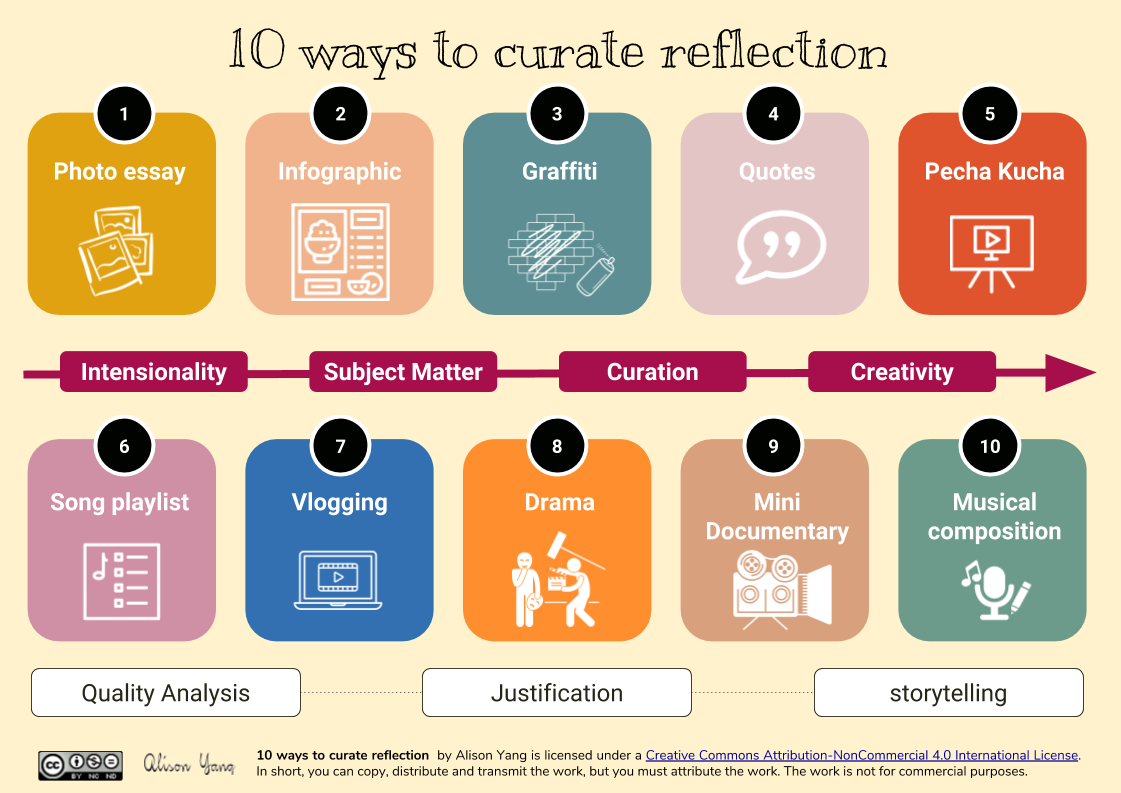
10 ways to curate reflection

I have brainstorm 10 ways to curate reflections. (Curating about curation!) 
  1. Photo essay: Students choose a series of photos that capture their learning and thinking. They give captions and write short paragraphs to each photo selected. 
  2. Infographic reflection: Students organize and communicate learning in a graphic format, which is a combination of texts, icons, charts, graphs or images. Encourage students to consider how fonts, colors,  graphics, and imagery can help convey an effective visual message.  
  3. Graffiti: Student can create a "graffiti wall" manually or digitally that captures their learning. 
  4. Quotes: Teachers can provide a page of quotes or have students search quotes from books or from the internet. Students choose relevant quotes relating to their learning and provide explanation.   
  5. Phecha Kucha: Phecha Kucha means "chit chat" in Japanese. It's a powerpoint presentation and presenters can only allowed 20 slides and those slides must automatically advance every 20 seconds. Phecha Kucha style presentation focuses on visuals, rather than text-heave texts.  
  6. Song playlist: Students select perhaps songs from Youtube or Spotify. They can use lyrics from the song to make connections with their learning. Alternatively, they can also create a top ten list to reflect on their learning. 
  7. Vlogging; Students create a short video to reflect on their learning and post it on their website (or their e-portfolio). It will be useful to discuss with students what vlog is and key elements in a vlog. Additionally, teachers can also share with students a couple of good vlogs.  
  8. Drama: Students can create a drama performance, such as monologue, skit or pantomime to share their learning. 
  9. Mini documentary: A mini documentary is one way to share stories and convey a message. 
  10. Musical composition: students can compose a piece or write a song that captures their learning. (Alternatively, they can also choose a song and create a music video.)     
All these reflective practices will require quality analysis from students and should be followed up by their justification. I hope these reflective practices can help our students share their stories with a wider audience and develop their creativity. 
Picture
Critical reflection is the process by which curiosity and experience can lead to deeper understanding. Learners must become critically aware of the way they use evidence, methods and conclusions. Reflection also involves being conscious of potential bias and inaccuracy in their own work and in the work of others. (MYP: from principles into practices, 11)  

Reference:

  • Burvall, Amy, and Dan Ryder. Intention: Critical Creativity in the Classroom. EdTechTeam Press, 2017.
  • Gonzalez, Jennifer. “To Boost Higher-Order Thinking, Try Curation.” Cult of Pedagogy, 21 Sept. 2018, www.cultofpedagogy.com/curation/.​
  • ​International Baccalaureate. MYP: from principles into practices. 
0 Comments

Reflection sticky notes

2/5/2018

0 Comments

 
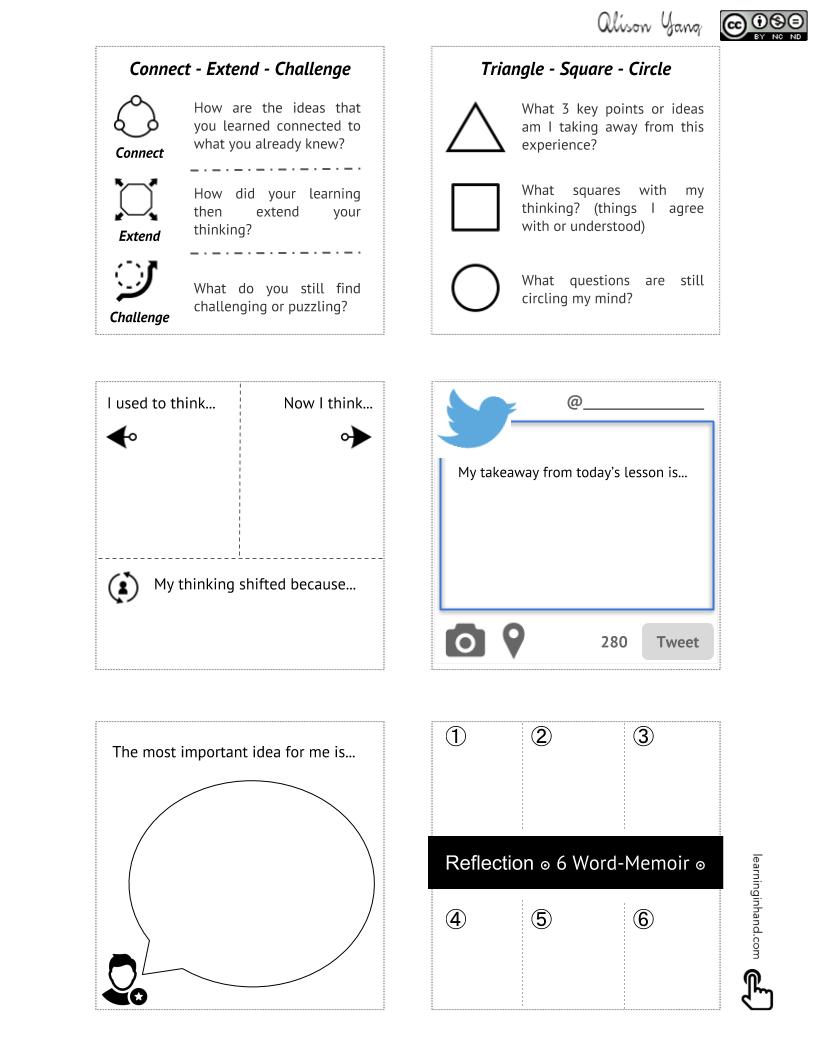
This post is writing to share various reflection protocols on the customized stikcy notes. Protocols included: 
  • Connect - Extend -Challenge
  • Triange - Square - Circle 
  • I used to think... Now I think... My thinking shifted because...
  • Tweeter template 
  • The most important idea for me is...
  • 6-word memoir 
Picture
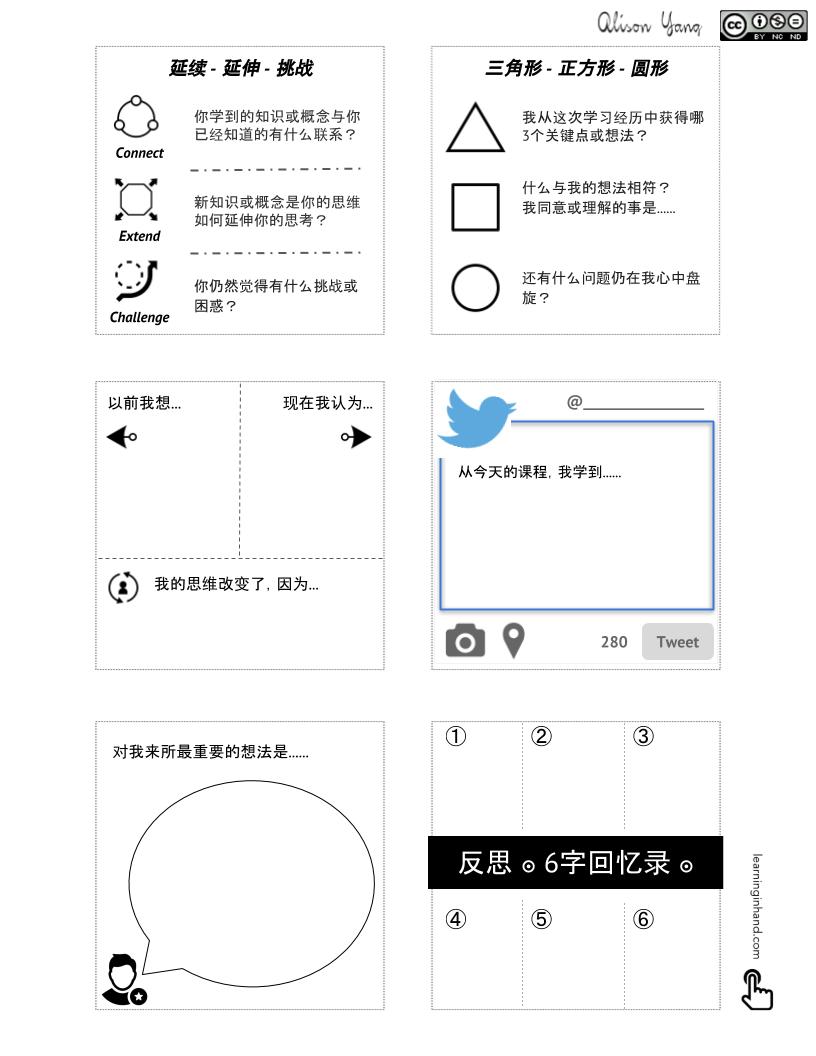
Reflection should not be a tedious process. Instead, reflection is a process that helps us develop identity and to undersatnd the meaning of our experiences. To facilitate student thinking and help students reflecting crtically and creatively, the role of the teacher is essential. The teacher must value reflection and act as a mentor by asking thoughtful questions and employing different strategies to promote personal development of students. Here are some sticky notes that I have created to support reflection. 
You can download the template here: 
https://docs.google.com/presentation/d/1PgCIPVrj70amUgMfz4HRinanQwtx13DAsLjLX6ortQ/template/preview 
If you are interested in making your own sticky notes, you can find clear instructions via Tony Vincent's website, Learning in Hand. In Tony's website, you will also find the printing instructions. 
Picture
Picture
This work is licensed under a Creative Commons Attribution-NonCommercial 4.0 International License. In short, you can copy, distribute and transmit the work, but you must attribute the work. This work is not for commercial purposes.  ​

Reference

Costa , Arthur L., and Bena Kallick. “Chapter 12. Learning Through Reflection.” Learning Through Reflection, www.ascd.org/publications/books/108008/chapters/Learning-Through-Reflection.aspx.
0 Comments

Reflective Writing Guide

27/4/2018

2 Comments

 
This post is writing to introduce a reflection protocol: What? So What? Now what? to promote student reflection and critical thinking. 
Picture

Reflection Protocol: What? So What? Now what?  

Agile learners take time to reflect on their learning experiences and analyze their strengths and areas for improvement. They evaluate their performance based on evidence gathered. This is an important process for the learners to evaluate their learning and analyze their performing. School can become very busy and fast-paced for teachers and students. "Rigor" is a catch phrase in education and sometimes I think it cause more harm than good. The meaning of the word, "rigor", is very often misinterpreted and as a result, students are bombarded with endless content, class and assignments.

In order for real learning to take place, I feel an individual must be given time and space to think and reflect. If we want to develop self-regulated learners, time and space must be provided for students to reflect and develop self-awareness of the challenges and obstacles they have encountered with. Furthermore, through critical reflection, learners can become mindful of their own feelings and learn how to cope with different emotions. The process of recognizing different types of emotions and acquiring strategies helps students to develop grit. Reflection plays a critical role in learning and we need to guide students to conduct reflect critically and go beyond the superficial level. 

"What? So What? Now What?" is a good protocol to challenge students to reflect beyond the surface level and require them to evaluate and analyze their performance. I found providing prompt questions and sentence starters is helpful and can scaffold students who are not yet comfortable in thinking and reflecting independently. Additionally, reflect comes in different formate. It doesn't always have to be written responses. Students should be encouraged to explore different ways for reflection.  

Feel free to make and copy and with your students.  
​docs.google.com/presentation/d/1n89aGOnqpyNVrccHR58DxQSrNbr6Dh-N0ycboBqFt88/template/preview 

Note: Permission was granted by Portsmouth University to use the sentence starters. Full credits are given to Portsmouth University in this poster. 
This work is licensed under a Creative Commons Attribution-NonCommercial 4.0 International License. In short, you can copy, distribute and transmit the work, but you must attribute the work. This work is not for commercial purposes.  
2 Comments
<<Previous

    αℓιѕση уαηg

    IB Educator, Learner, Workshop leader, Conference presenter, Educational graphic designer  
    Write to share and reflect! 

    Tweets by @alisonkis

    Categories

    All
    Assessment
    ATL Skills
    Digital Speaking
    Inquiry
    Mandarin Ab Initio
    MYP Criteria
    MYP Personal Project
    MYP Unit Planning
    PD
    Personal Reading
    Raising Trilingual Children
    Reading Strategies
    Reflection
    Second Language Acquisition
    Technology Integration
    Technology Integration
    Transitions

    RSS Feed

Powered by Create your own unique website with customizable templates.